
Know the Market, Not the Narrative: Part Two
I don’t judge the housing market by one headline, one interest rate, or one national statistic. The market is rarely as good or as bad as the news makes it sound.
I recently reviewed Lawrence Yun’s Economic and Housing Market Outlook from the National Association of REALTORS®. The data confirmed what many of us are seeing firsthand: this is not one housing market. It is a market divided by location, price point, equity, employment, and each consumer’s financial position.
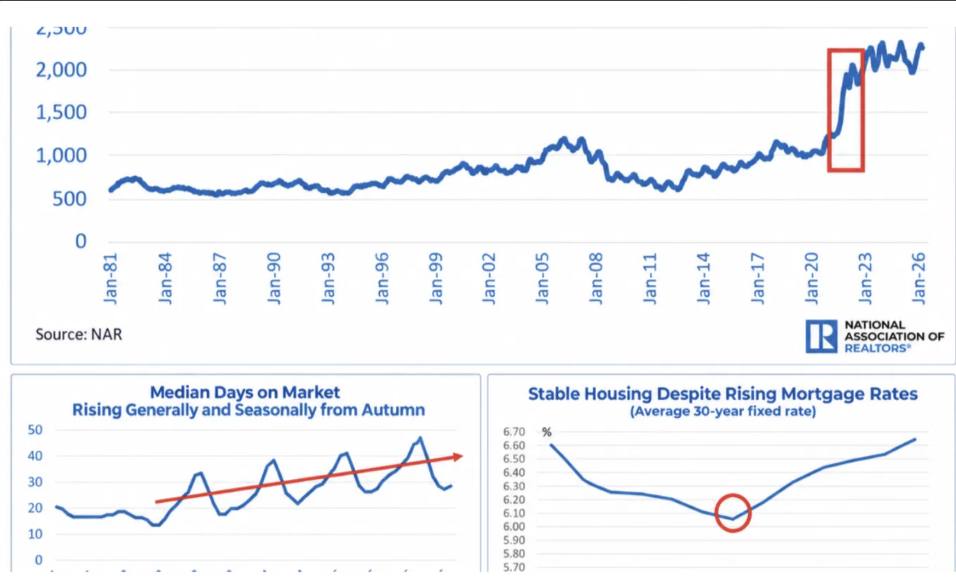
Home sales remain historically low, but the total dollar volume of real estate sold was up 4 percent year to date, driven largely by higher-priced properties. At the same time, the number of homes valued at $1 million or more increased 368 percent between 2005 and 2024.
Some of that is inflation. Construction costs, land, labor, and insurance have all climbed since 2005, and a home that would have listed for $600,000 back then costs far more to build or buy today. A million-dollar price tag does not carry the same weight it did 20 years ago. But it is not only inflation. Some consumers have substantial equity and financial flexibility, while others are struggling with affordability and higher borrowing costs. It is a K-shaped economy, and we are seeing that divide play out in real estate.
Mortgage Rates Are Only Part of the Story
The average 30-year mortgage rate has remained stubbornly above 6 percent. Inflation was still running above the Federal Reserve’s 2 percent target, and long-term interest rates remained under pressure from government borrowing, a tight labor market, energy prices, and the money pouring into artificial intelligence and technology. Anyone confidently predicting exactly where mortgage rates will be six months from now is guessing.
Rates matter, but they are not the only number that matters. The monthly payment required to purchase a typical home rose sharply after the Federal Reserve began increasing rates in 2022. That has reduced buying power and pushed many buyers to the sidelines.
But renting isn’t a bargain either. Rents have continued to climb, while a fixed-rate mortgage payment remains relatively stable over time. A buyer’s payment may feel high today, but rent can continue increasing year after year. That doesn’t automatically make buying the right decision. Consumers need to compare the long-term cost of both choices instead of looking only at today’s monthly payment.
The Lock-In Effect Is Changing
For several years, we have talked about homeowners feeling locked into mortgage rates of 3 or 4 percent. That is still a major factor, but it is slowly changing.
More than 16 million existing homes have sold since September 2022, when mortgage rates moved above 6 percent. That means more homeowners now have loans closer to current rates. Over time, the difference between the rate they have and the rate they would receive on their next home becomes smaller.
Life also continues regardless of interest rates. People get married, have children, change jobs, retire, inherit property, divorce, relocate, and need different homes. Eventually, the reason for moving becomes more important than protecting an old mortgage rate.
Buyers Have More Room to Think
Homes are taking longer to sell. Fewer are going above the asking price. That doesn’t mean buyers suddenly control every market. A well-priced home in a desirable Northern Virginia neighborhood can still sell quickly and receive multiple offers.
But buyers may have more opportunities to negotiate inspections, closing costs, repairs, or other terms than they did during the most frantic years of the market. The mistake would be assuming that every seller is desperate or every listing is overpriced. Leverage depends on the property, the competition, the seller’s motivation, and how long the home has been on the market.
The Market Is Local, but Strategy Is Personal
One slide in the presentation stood out to me. Payroll employment within Washington, D.C. itself is approximately where it was in 1990. After 36 years of watching the market, that is a surprising number and will trickle down to the housing market.
That does not tell us what will happen to every home in Northern Virginia, but it is a reminder that employment trends matter. Fairfax, Alexandria, Arlington, Prince William, Loudoun, and the District can experience very different levels of demand. Condominiums can behave differently from townhomes, and one neighborhood can have multiple offers while another 7 miles away is seeing price reductions.
National data gives us context. Local data tells us what is happening. A person’s financial situation determines what they should do about it.
For sellers, this means pricing cannot be based on what a neighbor received two years ago. Buyers have more choices, higher payments, and less patience for properties that are overpriced or poorly prepared. For buyers, waiting may feel safer, but waiting has a cost. Home prices, rents, and interest rates do not move together or on a predictable schedule.
The better question is not, “Is this the perfect time to buy?” It is, “Does buying this property make sense for my finances, my plans, and the length of time I expect to own it?”
For agents, this market requires more than repeating headlines or quoting an online estimate. We need to understand financing, inventory, days on market, seller motivation, buyer competition, and the economics of the specific property.
The housing market is not frozen. It is more selective, more divided, and less forgiving of weak strategy. Some buyers should purchase now. Some should wait. Some sellers should list. Others may be better served by improving the property, adjusting their expectations, or reconsidering their timing. The right answer depends on the numbers, the property, and the person.
Most of these statistics show us the national picture. But real estate decisions are not national. Know your zip code better than you know the headline.
Know the market, not the narrative.
Then make the decision that works for your life, not the decision someone on television tells you to make.
Source: Lawrence Yun, Chief Economist, National Association of REALTORS®, Economic and Housing Market Outlook, August 2026.


Leave a Reply